

UWB Solution for Tunneling Advance Measurement

UWB Solution for Tunneling Advance Measurement
Current Status and Pain Points

♦Low Operation Efficiency
At present, the measurement of underground tunneling footage mainly relies on manual tape measurement and laser pointers. Laser pointers need to be moved forward frequently, resulting in spot drift, which increases the rework rate of cross-section remeasurement.
♦Poor Data Real-Time Performance
Data transmission depends on paper ledgers or handheld terminals. The shift footage can only be entered into the dispatching system after returning to the ground, failing to achieve real-time updates.
♦Low Data Reliability
Key indicators such as temporary support, blasting progress, and bolt row spacing lack a unified coordinate system. The cross-section is affected by dust, water dripping and vibration, leading to errors in tape reading. Over-breakage and floor heaving in rock roadways are common. Inconsistent statistical calibers among shift reports, daily reports and weekly reports cause gradual accumulation of deviations in mining and excavation connection plans.

Functional Requirements
♦Data Accuracy:Realize precise measurement and real-time positioning of the tunneling face via UWB high-precision ranging, reducing human errors.
♦Environmental Adaptability:Achieve stable centimeter-level distance output under dust, water mist and non-line-of-sight conditions through UWB high-precision ranging.
♦Data Anti-falsification:UWB ranging supports real-time data return, and real-time ranging is also performed between ranging anchors. Once the mobile ranging base station is moved, the distance change information can be viewed in the background.

Non-functional Requirements
The measurement of underground tunneling advance footage is primarily constrained by high-concentration dust and water mist. Laser and optical measurement methods are prone to light scattering and obstruction, resulting in signal loss or unstable readings. Humid air causes corrosion of metal components and a sharp drop in reflectivity, which attenuates echo signals and drastically increases measurement errors. Sustained blasting and mechanical vibration loosen instrument brackets and shift laser alignment. Meanwhile, shift rotations and frequent personnel movement introduce human interference; raw data errors are easily amplified through selective sampling. The absence of continuous reference points further accumulates measurement deviations, ultimately leading to overreported or underreported footage, which impairs output assessment and the accuracy of hazard early warning. Conventional manual surveying and laser instruments are far more susceptible to environmental interferences. To achieve precise tunneling advance footage measurement under such harsh underground conditions, the system must feature high precision, real-time responsiveness, outstanding reliability, and fully unmanned operation. UWB high-precision ranging technology serves as an all-in-one effective solution to resolve the aforementioned challenges in terms of measurement accuracy, real-time performance, environmental adaptability, deployment simplicity, and overall cost control.
 
UWB High-Precision Tunneling Advance Footage Measurement Solution
 
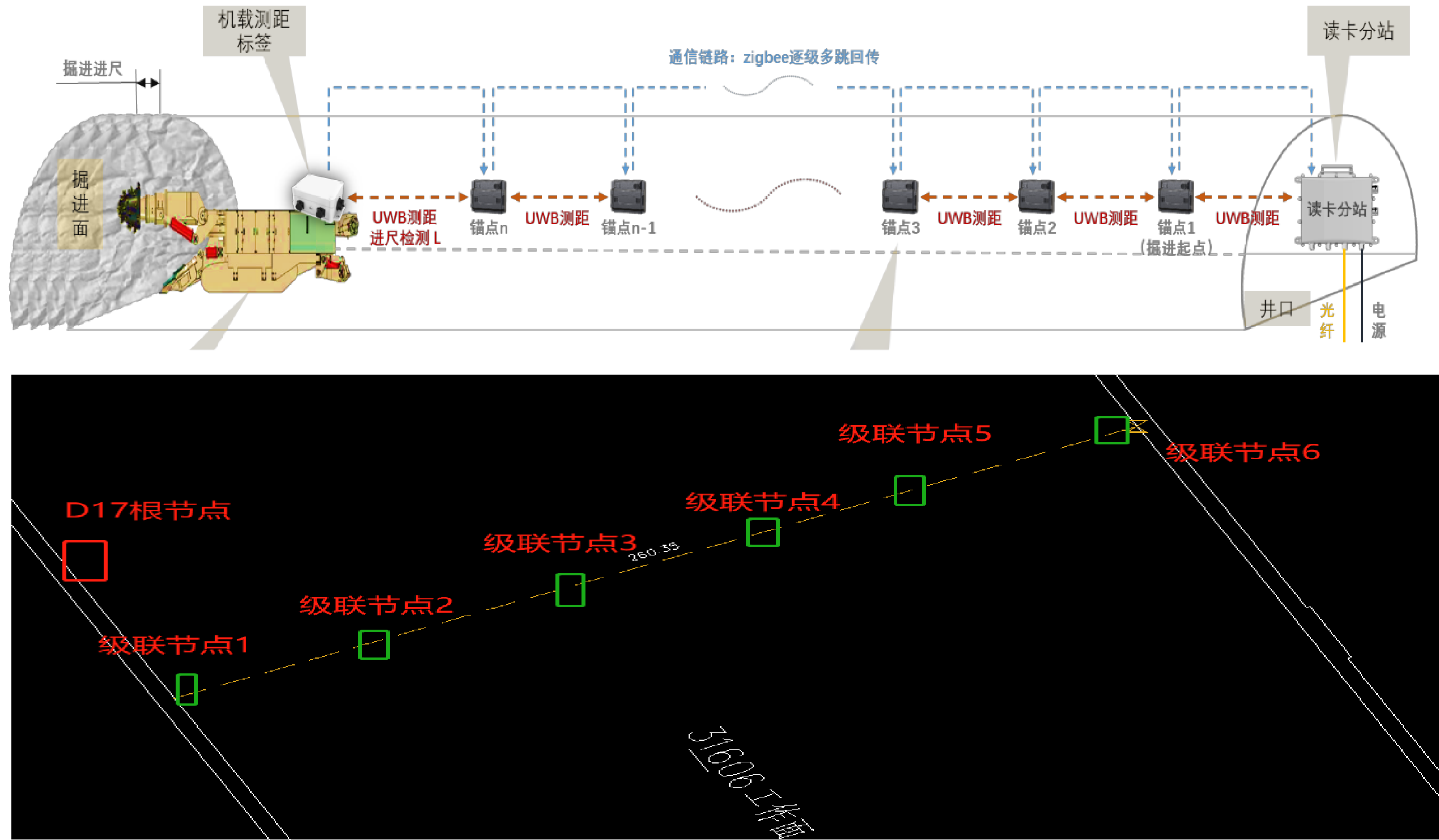
1.Card readers are installed at roadway entrances as root nodes, and positioning nodes are arranged along the heading face for full signal coverage. Positioning tags are mounted on roadheaders to realize UWB high-precision ranging, with data transmitted to the surface positioning server in real time via card readers.
 
2.The ranging base stations and positioning tags deployed on site have obtained mining safety and explosion-proof certifications and comply with relevant environmental requirements. UWB ranging technology inherently features strong resistance to heavy dust, high humidity, intense vibration and electromagnetic interference, making it adaptable to complex underground environments.
 
3.All positioning nodes deployed on site follow a strict topological relationship. Raw data is transmitted upward level by level through the nodes and connected to the ring network via positioning base stations. Ranging is also performed between each positioning node; any manual tampering will generate abnormal data records in the background system.
 
In addition to footage measurement, within the coverage of on-site base stations, personnel and material location management can be realized by wearing personnel positioning worker badges, safety helmet tags and material tags.
 
Solution
Single Base Station Ranging Scheme
Multi-base Station Wireless Multi-hop Ranging Scheme
Single Base Station Ranging Scheme
Multi-base Station Wireless Multi-hop Ranging Scheme
 
Single Base Station Ranging Scheme

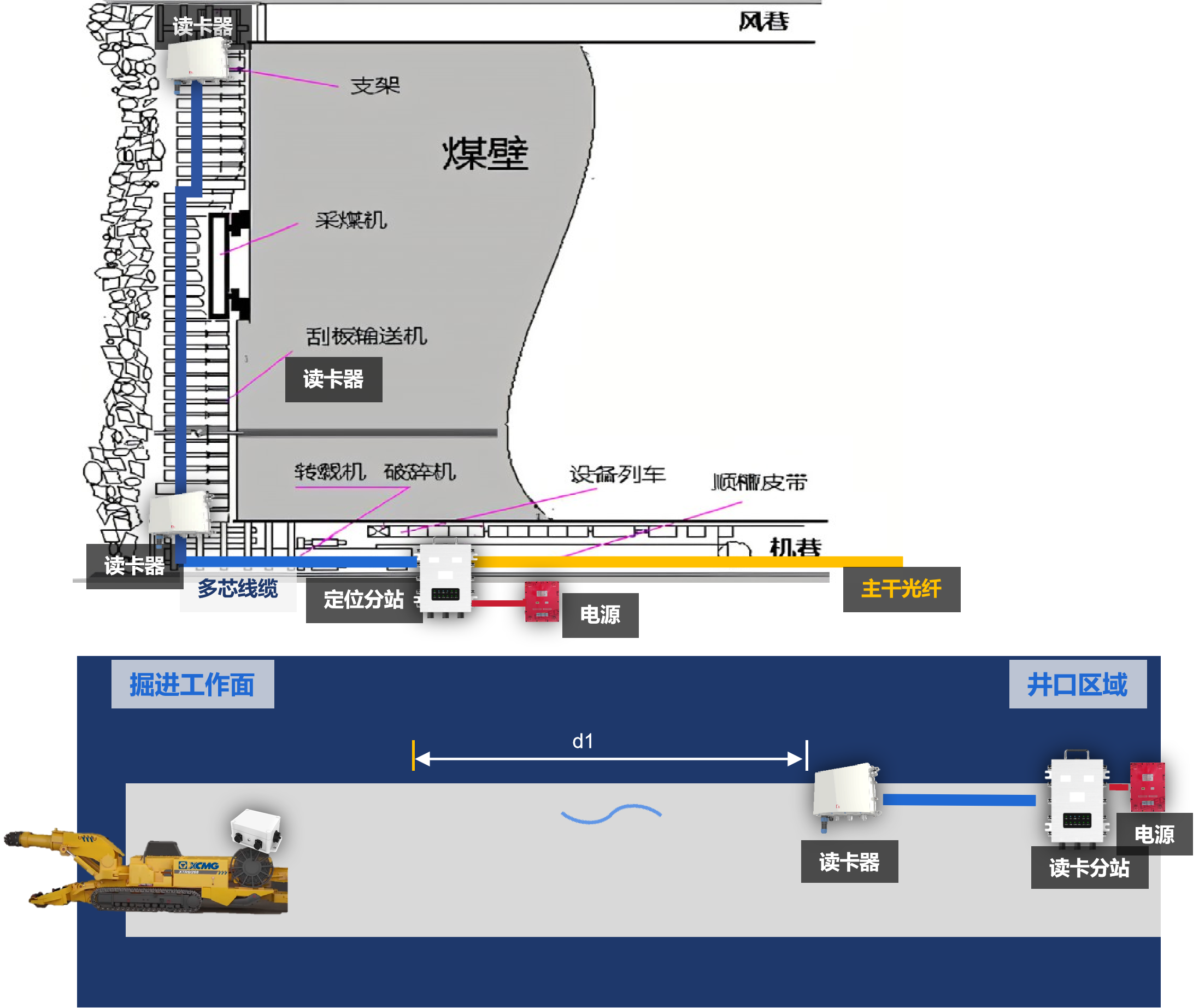
For footage monitoring of coal mining faces, it is necessary to collect position, displacement and time data of all major mobile equipment on the fully-mechanized mining working face to realize real-time monitoring of coal mining footage. For footage calculation of heading faces, the card reader at the roadway entrance is taken as the reference point. First, UWB ranging is adopted to obtain the precise coordinate distance d1 from the reference point to a certain section, which serves as a fixed reference point. Then UWB technology is used to conduct precise ranging of dynamic targets on this section to get d2, so the cumulative footage is calculated as d = d1 + d2. The daily heading footage equals the d2 value of the current day minus the d2 value of the previous day, while the daily mining footage equals the d2 value of the previous day minus the d2 value of the current day.


Multi-base Station Wireless Multi-hop Ranging Scheme

(1) Install On-board Identification Tags Mount on-board identification tags on tunneling equipment. The tags support power supply via built-in batteries or local 9–24 V DC power.
(2) Deploy Ranging Anchors Fix or hang ranging anchors within a 0–100 m range from the tunneling equipment. These anchors measure the real-time distance L to the on-board tags, and footage data is calculated in real time based on the distance L and position data of footage anchors.
(3) Deploy Transmission Equipment Install communication base stations at roadway openings to establish communication links with anchor devices. The base stations configure parameters such as the measurement frequency of ranging devices, and receive distance values L between anchors and on-board identification tags transmitted by anchor devices. (4) Addition of New Anchor Devices As the tunneling machine advances forward, new tunneling footage ranging anchors shall be added once the on-board tag moves beyond the maximum ranging distance of the existing anchor. Anchors support mutual ranging and communication. Anchor n transmits the distance value L back to the communication base station via Anchor n-1, Anchor n-2 … Anchor 1 in sequence.
 
System Advantages

High real-time data performance:Measurement data is transmitted back to the communication station via Anchor n, Anchor n-1, Anchor n-2, …, Anchor 1, and then sent to the ground server in real time.
High data accuracy:Thanks to the strong environmental adaptability of UWB technology, high-precision ranging can be achieved in complex underground environments.
Data anti-falsification:Strict topological relationships are followed among all on-site positioning nodes. Raw data is transmitted upward level by level through nodes, preventing manual equipment movement or data tampering.
Quick deployment:Rapid ranging and networking can be realized between on-site positioning nodes, as well as between positioning nodes and the root node.
Low maintenance cost:Wireless base stations feature nearby power access, built-in antennas, and a lower risk of damage from roof fall compared with vehicle-mounted devices, resulting in a low overall maintenance cost.
Reuse of personnel positioning:Cascaded base stations can realize UWB signal coverage in roadways. In addition to tunneling footage measurement, they can also achieve accurate personnel positioning.

Personnel Positioning and Anti-Collision Management for Thin Coal Seams
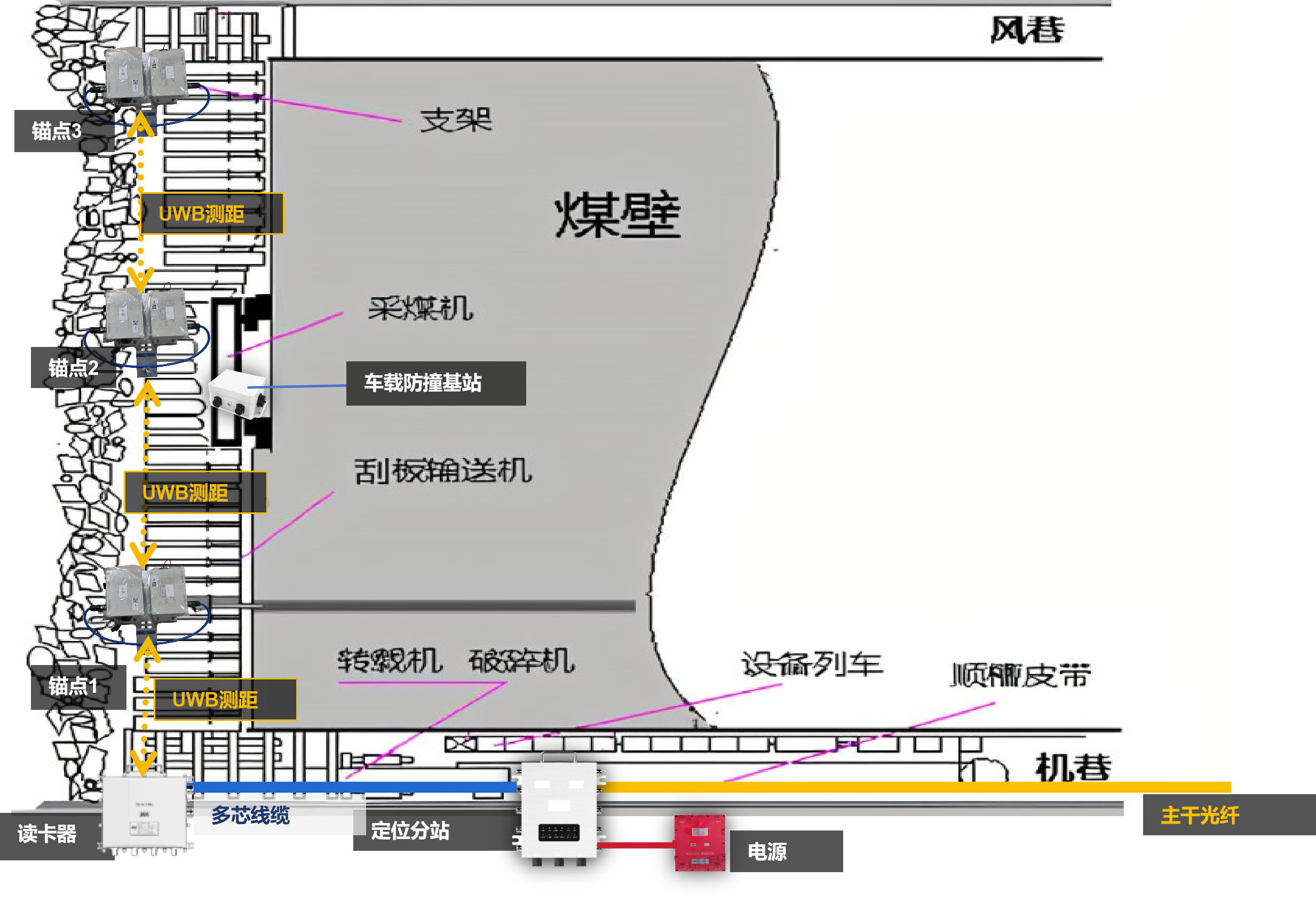
Personnel Positioning & Anti-Collision for Thin Coal Seam Working Faces
 
Adopting UWB high-precision wireless ranging technology, ranging base stations are deployed in cascade on hydraulic supports. These base stations move along with the supports to form a dynamic, self-organizing wireless network. The system monitors the precise positions of all personnel wearing positioning tags and mobile equipment such as shearers inside the working face in real time. It immediately triggers alarms and interlocks equipment shutdown once a collision risk is predicted.
Cascade Communication: Base stations are cascaded via Zigbee. Ranging data is transmitted to the root node card reader through multi-hop transmission. To adapt to the movement of supports, the base stations support fast roaming and self-healing network topology.
UWB Tags: Worn by staff (waist badges or integrated into miner lamps) or mounted on mobile equipment (shearers, shuttle cars). The tags periodically transmit pulse signals for base stations to perform positioning and ranging.
Personnel Positioning and Anti-Collision Management for Thin Coal Seams
Main Products
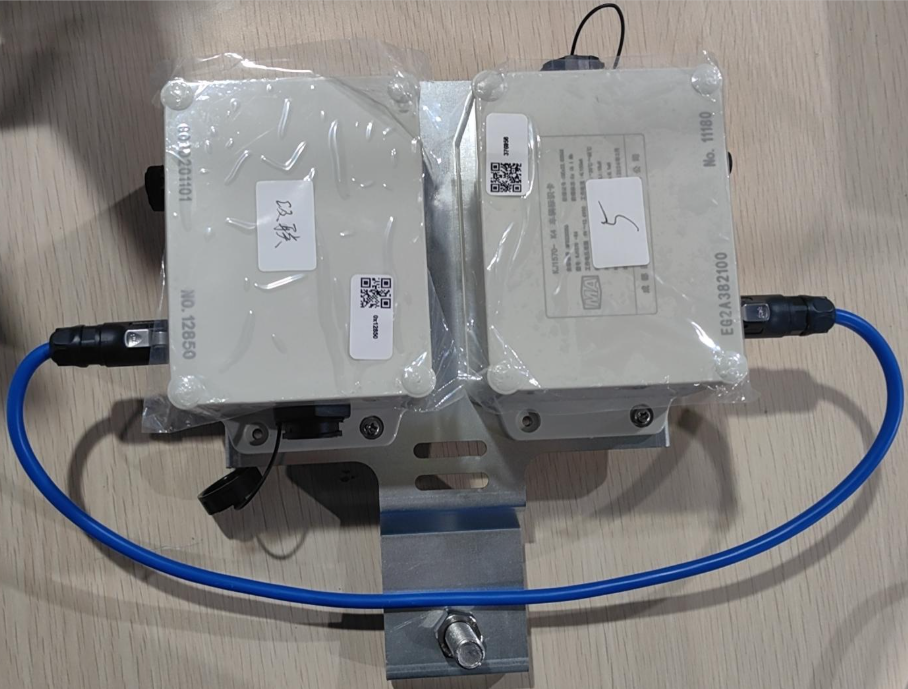
Wireless Cascaded UWB Positioning and Communication Base Station


Wireless Cascaded UWB Positioning and Communication Base Station

Product Weight: ≤1.3kg
External Power Supply: 4-pin aviation plug (red positive, blue negative)
Protection Grade: IP67
Positioning Wireless Standard: 802.15.4_2011 UWB
Positioning Method: TOF/TDOA
Communication Wireless Standard: 802.15.4_2.4GHz
Scroll to Top